Selecting the right fastener for rain, salt, humidity, and temperature changes requires more than choosing stainless steel. The real question is: How to select fasteners with good weather resistance? This guide introduces seven practical tips for making that decision. It considers base metal, protective coatings, installation conditions, joint design, and long-term maintenance.
Herbert H. Uhlig, a respected corrosion engineer, wrote, “Corrosion is the destruction of metals by chemical or electrochemical reaction with their environment.” His statement explains why outdoor fasteners need careful evaluation. A bolt beside a coastal walkway faces salty air, standing water, and abrasive dust. A fastener beneath a roof may experience condensation instead. The same product cannot perform equally well in every location.
Small details matter. Check the fastener grade, coating thickness, and contact metals. Avoid careless combinations that can create galvanic corrosion. Review testing such as ASTM B117 or ISO 9227, but do not treat laboratory hours as a guaranteed service-life promise. Real weather is less controlled. Wind-driven rain can enter threads. Damaged coatings can expose hidden steel. Installation errors can also shorten performance.
No single fastener wins every site.
These seven tips will help buyers compare stainless steel, hot-dip galvanized, coated, and specialty fasteners more responsibly. They also encourage a necessary reflection: the cheapest option may become expensive after rust stains, seized threads, or replacement work appear. Good selection depends on evidence, field experience, and honest attention to the environment surrounding every connection.
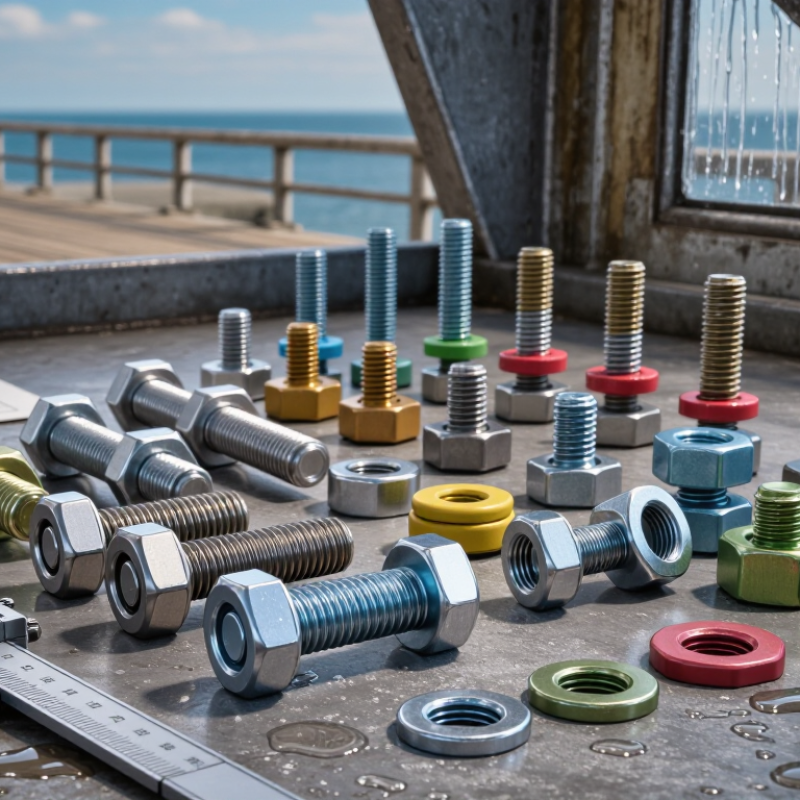
Weather-resistant fasteners should match the actual exposure, not just the forecast. Start by defining moisture, salt, temperature, and chemical contact. A coastal railing may face salt spray, wind-driven rain, and repeated drying. An indoor warehouse may still experience condensation near loading doors. Small details matter.
Tip 1: Map the exposure zone before choosing the fastener. ISO 12944 classifies atmospheric corrosivity from low indoor conditions to extreme offshore environments. Its categories help engineers compare sites more consistently. The NACE IMPACT study estimated global corrosion costs at about US$2.5 trillion annually, or 3.4% of global economic output. That figure shows why early material selection deserves attention.
Tip 2: Check how often the surface stays wet. Long wet periods usually create greater corrosion risk than brief rainfall. Look for drainage problems, trapped water, and narrow joints around washers. Chlorides can concentrate after water evaporates. Cold climates add another concern: freeze-thaw cycles can damage coatings and open small paths for moisture. ASTM B117 salt-spray testing can support comparisons, but it does not perfectly reproduce every outdoor site. This is where judgment is needed.
Tip 3: Consider contact with surrounding materials. Dissimilar metals may create galvanic corrosion, especially in wet or salty conditions. Use compatible washers, isolate contact points, and inspect cut edges. A fastener can look sound while corrosion grows beneath its head. I would not rely on the term “weather resistant” alone. Site records, exposure mapping, and scheduled inspections often reveal risks that a product label misses.
| Tip | Weather Condition or Exposure | Primary Corrosion Risk | Suitable Fastener Material or Finish | Selection Guidance | Recommended Inspection Interval |
|---|---|---|---|---|---|
| 1 | Indoor, dry, climate-controlled areas | Low humidity and limited condensation; occasional surface rust may occur on unprotected carbon steel | Zinc-plated carbon steel or corrosion-resistant coated steel | Use a finish rated for the actual indoor humidity and chemical conditions; avoid relying on appearance alone to determine protection. | Every 12–24 months |
| 2 | Outdoor rainfall, snow, and normal humidity | Repeated wetting and drying, trapped moisture, and coating breakdown | Hot-dip galvanized steel or suitably coated structural fasteners | Choose a coating thickness appropriate for the expected service life. Prevent water traps and allow drainage around the joint. | Every 6–12 months |
| 3 | Coastal air, sea spray, or de-icing salt exposure | Chloride-induced pitting, crevice corrosion, and accelerated galvanic attack | Appropriately selected stainless steel or a marine-rated corrosion-resistant system | Select the stainless grade according to chloride severity. Do not assume every stainless steel grade has the same resistance to salt exposure. | Every 3–6 months |
| 4 | Industrial, agricultural, or urban pollution | Acidic or alkaline deposits, sulfur compounds, ammonia, and chemical condensation | Stainless steel or a tested protective coating compatible with the specific chemicals | Identify airborne chemicals before selection. A general-purpose outdoor coating may be unsuitable in a process or agricultural environment. | Every 3–6 months |
| 5 | Continuous moisture, condensation, or submerged service | Oxygen-differential corrosion, crevice corrosion, and loss of protective coating | Fasteners specifically rated for wet or submerged service; use compatible sealing components where required | Confirm immersion depth, water chemistry, temperature, and required service life. Design joints to minimize crevices and stagnant water. | Every 1–3 months |
| 6 | High ultraviolet exposure and large temperature changes | Seal degradation, thermal movement, coating embrittlement, and moisture entry | UV-stable coated fasteners with compatible washers, gaskets, or sealants | Check the complete fastening system, not only the metal fastener. Allow for differential thermal expansion between joined materials. | Every 6–12 months |
| 7 | Contact between dissimilar metals or treated timber | Galvanic corrosion, tannin-related staining, and chemical attack from wood preservatives | Compatible fastener and washer combination; use suitable isolation barriers where needed | Verify material compatibility, electrical contact, moisture retention, and preservative treatment. Isolate dissimilar metals when practical. | Every 6 months |
Match the coating to the exposure. A sheltered patio needs less protection than a coastal railing. Salt air and standing water require proven corrosion resistance. A glossy finish can still fail early.
Check humidity, salt spray, road splash, standing water, temperature changes, and chemical contact. Look for water trapped beneath washers or inside joints. Small details matter.
Dissimilar metals can create galvanic corrosion when moisture is present. For example, coated steel touching aluminum may produce white corrosion around the connection. Choose compatible fasteners, washers, nuts, and brackets.
Check thread type, diameter, strength, coating thickness, temperature range, and recommended torque. Review corrosion-test data instead of trusting vague terms like “weather resistant.” The weakest component may fail first.
No. A screw designed for timber may not hold properly in masonry or thin sheet metal. Match the thread and strength to the assembly. I have sometimes seen suitable-looking screws used in the wrong material.
Over-tightening can damage coatings, crush timber, or distort panels. Under-tightening allows movement and water entry. Use the correct pilot hole, tightening method, and torque range.
Inspect cut edges, threads, scratches, and coating damage. Small exposed areas can become entry points for rust. Keep threads clean, and avoid improvised lubricants that change torque readings.
Inspect connections for rust stains, looseness, cracked coatings, and trapped moisture. Clean deposits with a compatible method. Replace damaged parts rather than covering them with paint. No system is maintenance-free.
Set inspection dates and record environmental changes. Check more closely after heavy rain, coastal exposure, or visible staining. A carefully selected fastener can still fail when water collects beneath a washer.
Choosing durable outdoor fasteners starts with understanding the environment they will face. Consider humidity, rainfall, salt spray, temperature changes, chemicals, and direct sunlight, as each condition can increase corrosion or material fatigue. How to select fasteners with good weather resistance depends on matching the fastener material to the exposure level, such as choosing corrosion-resistant metals for damp or coastal locations and using suitable protective coatings for additional outdoor protection.
Beyond corrosion resistance, confirm that the fastener has the correct strength, size, thread type, and load capacity for the application. Proper compatibility with the joined materials is also essential to prevent reactions, loosening, or premature failure. During installation, follow appropriate tightening practices and avoid damaging the coating or threads. Regular inspection and maintenance can identify rust, wear, or looseness early, helping extend service life and maintain the safety and reliability of the entire assembly.

 VLC Part